
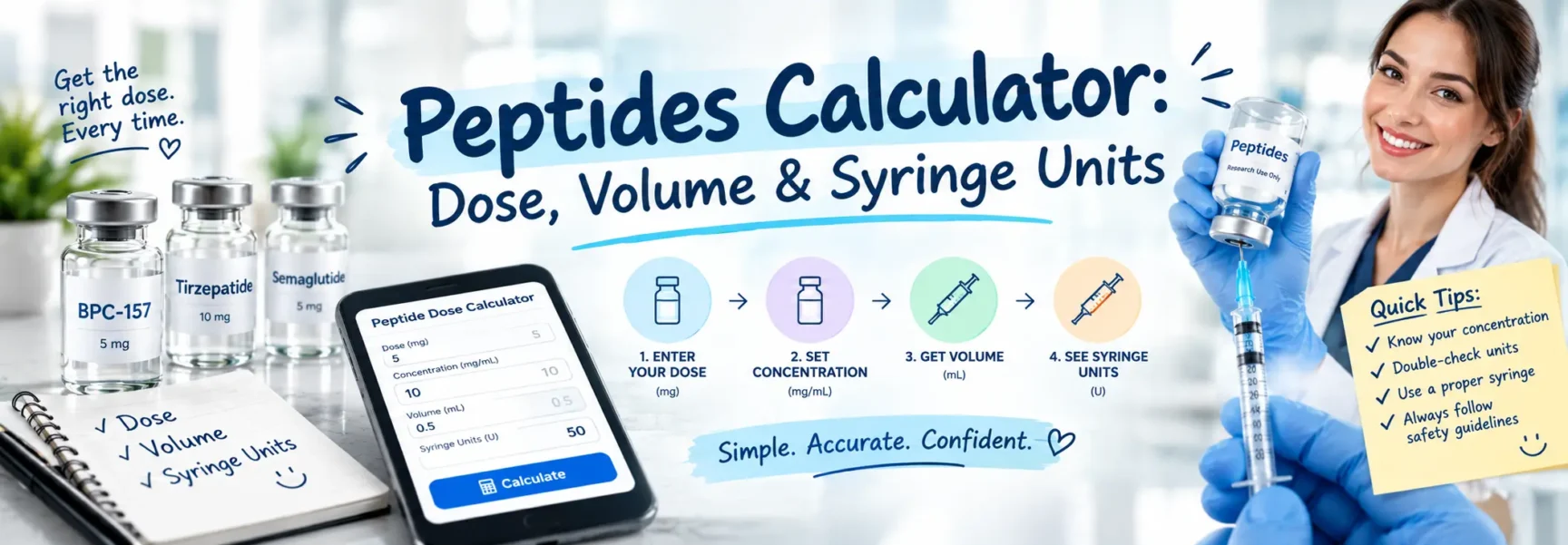
A tiny decimal can make a very big difference when you’re reconstituting a peptide. A Peptides Calculator helps you translate the amount printed on a vial into concentration, injection volume, insulin-syringe units, and approximate doses per vial, without relying on shaky mental math at the kitchen counter.
This guide explains the calculations behind the tool so you can independently verify every result. You’ll also find worked examples for U-100 and U-40 syringes, practical reconstitution guidance, and troubleshooting for suspicious-looking answers.
Important: This is a math and measurement resource, not medical advice or a dosing protocol. It doesn’t determine whether a peptide is approved, appropriate, sterile, or safe for you. Many products marketed as “research peptides” aren’t approved for human use, and compounded drugs carry risks that an arithmetic tool can’t evaluate. Use only medication prescribed and dispensed by qualified, licensed professionals, and follow the product label plus your clinician’s and pharmacist’s instructions. If their directions conflict with a calculation here, stop and contact them before injecting anything.
Key Takeaways
- The peptides calculator converts vial strength and diluent volume into concentration, dose volume, syringe units, and estimated doses per vial to prevent calculation mistakes.
- Always use exact values from your prescription and supplies, including peptide amount, water volume, desired dose, and syringe type (U-100 or U-40) to ensure accurate results.
- Convert dose units properly between micrograms and milligrams before calculating injection volume using the formula: injection volume = desired dose ÷ concentration.
- Syringe markings differ significantly between U-100 and U-40; use only syringes correctly calibrated to your calculation to avoid dosing errors.
- The calculator estimates theoretical doses per vial but real yield may be less due to dead space or discard requirements; never extend beyond-use dates based on calculations.
- Verification by a pharmacist or qualified professional is essential before administering any dose, as the calculator does not evaluate safety, sterility, or product approval.
Peptides Calculator (Free Tool): Enter Vial Strength, Water Volume, and Target Dose
A peptides calculator solves a straightforward equation: it determines how concentrated your reconstituted solution is, then identifies the volume containing your prescribed target dose. A final conversion expresses that volume as syringe units.
Enter values exactly as they appear on your prescription and supplies. Don’t guess how much diluent was used, assume every insulin syringe is U-100, or copy a protocol from social media. The arithmetic may be universal: the appropriate dose absolutely isn’t.
Quick safety check: Confirm the peptide name, vial strength, diluent volume, prescribed dose, and syringe calibration before drawing a dose. Ask a pharmacist to verify your first calculation whenever possible.
Inputs you’ll need: peptide amount (mg), bacteriostatic water (mL), desired dose (mcg/mg), syringe type (U-100/U-40)
You need four values:
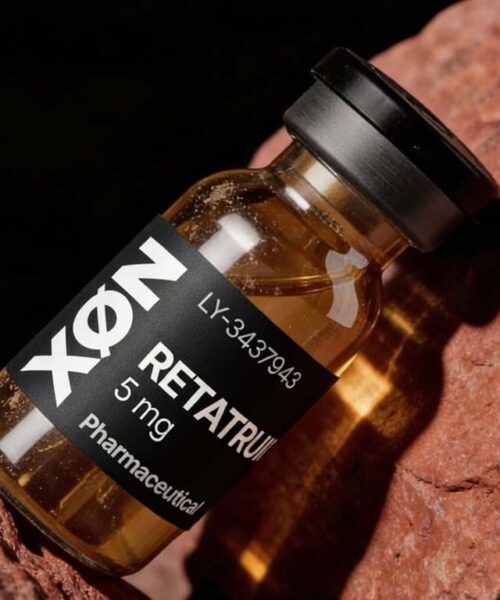
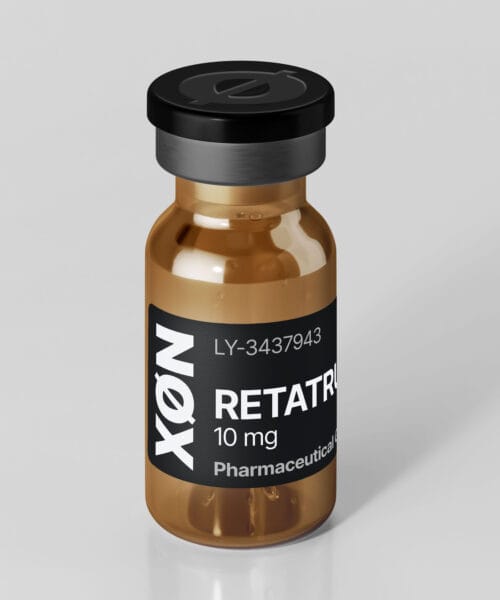
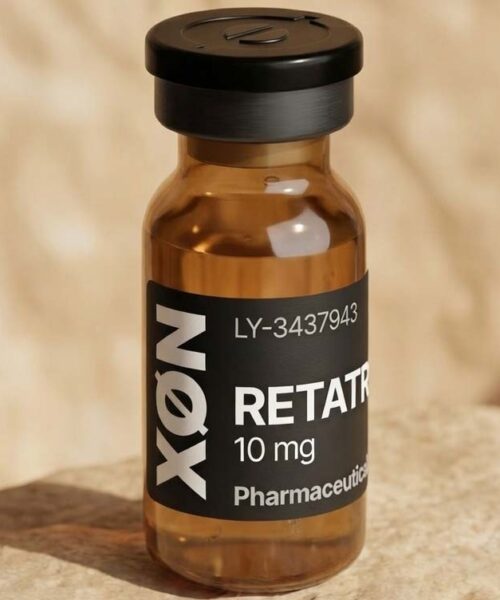
- Peptide amount: Total drug in the vial, commonly labeled 5 mg or 10 mg, not its concentration after mixing.
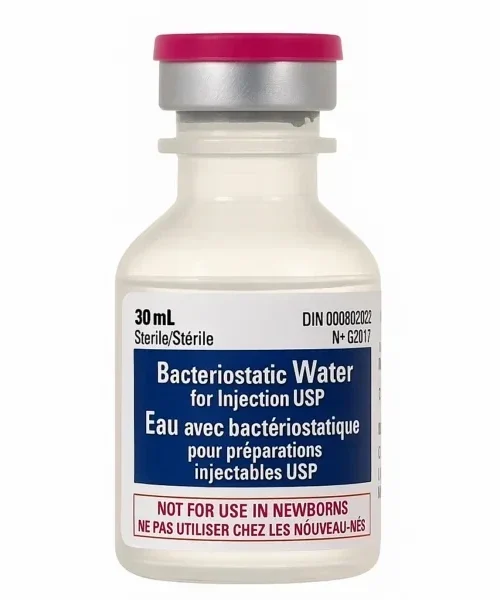
- Water volume: The exact diluent volume added, in milliliters. More water produces a less concentrated solution: it doesn’t create more peptide.
- Desired dose: The amount prescribed for one administration. Check whether it’s expressed in micrograms (mcg) or milligrams (mg).
- Syringe type: U-100 or U-40, printed on the barrel or package.
Use only the diluent and volume specified by the manufacturer, pharmacy, or prescriber. “Bacteriostatic water” isn’t automatically appropriate for every medication or patient. For example, product labeling may require sterile water, another supplied diluent, or immediate use. Never substitute tap, bottled, or homemade water.
A classic beginner mix-up is entering 250 mg when the instruction says 250 mcg. That’s a thousandfold difference. Pause whenever a result looks dramatically larger than expected.
Outputs explained: concentration (mg/mL), dose volume (mL), syringe units, doses per vial
The calculator should return four related, not interchangeable, answers:
| Output | Meaning |
| Concentration | Milligrams of peptide in each milliliter after mixing |
| Dose volume | Milliliters needed to contain the entered dose |
| Syringe units | Where that volume falls on the selected syringe scale |
| Doses per vial | Theoretical vial amount divided by the target dose |
“Doses per vial” is an estimate. Real-world yield can be lower because liquid remains in the vial or syringe, a needle has dead space, or the vial must be discarded before every theoretical dose is used. It also shouldn’t be used to extend a beyond-use date.
Round cautiously. If the result lands between syringe markings, say 7.5 units on a syringe marked only in whole units, don’t improvise. Your pharmacist can recommend an appropriately graduated syringe or revised concentration consistent with the prescription.
How to Calculate Peptide Dosage (Formula + Quick Steps)
You can audit any peptides calculator with three equations. Write the units beside every number: they behave like guardrails and reveal most mistakes before they reach a syringe.
- Concentration: vial amount ÷ diluent volume
- Injection volume: desired dose ÷ concentration
- Syringe units: injection volume × units per mL
The same calculation works for prescribed vial-based medications when the quantities are known. What changes is the clinically appropriate dose, diluent, storage period, and administration schedule.
Step 1: Calculate concentration (mg/mL) from vial strength and water added
Use:
Concentration (mg/mL) = peptide in vial (mg) ÷ water added (mL)
Suppose your labeled vial contains 5 mg and your verified instructions say to add 2 mL:
5 mg ÷ 2 mL = 2.5 mg/mL
That means every 1 mL contains 2.5 mg. Half a milliliter contains 1.25 mg, while 0.1 mL contains 0.25 mg.
Notice what didn’t happen: adding 2 mL didn’t turn the vial into “2.5 mg total.” The vial still contains 5 mg overall: the liquid merely distributes it at 2.5 mg per milliliter. If you instead added 1 mL, the resulting concentration would be 5 mg/mL, making each equal-volume draw twice as strong.
Use the volume actually added, not the vial’s physical capacity. A vial that can hold 3 mL may have been reconstituted with only 1 or 2 mL.
Step 2: Convert dose (mcg ↔ mg) and compute injection volume (mL)
First put the prescribed dose in the same mass unit as the concentration:
- 1 mg = 1,000 mcg
- Convert mcg to mg: divide by 1,000
- Convert mg to mcg: multiply by 1,000
A 250 mcg dose is hence 0.25 mg. With a concentration of 2.5 mg/mL:
Dose volume = 0.25 mg ÷ 2.5 mg/mL = 0.1 mL
The “mg” terms cancel, leaving mL. That little unit check is surprisingly useful. If your math leaves you with mg² or mL per mg, something took a wrong turn.
Keep full precision until the final result. Prematurely rounding a repeating value, such as 0.1667 mL, can distort later conversions. Then compare the final volume with the syringe’s smallest graduation. If it can’t be measured reliably, contact your pharmacist rather than eyeballing the space between lines.
Step 3: Convert mL to insulin syringe units (U-100 and U-40)
Insulin syringe “units” describe calibrated volume for a particular insulin concentration: they aren’t milligrams or micrograms of peptide.
- U-100: 100 units = 1 mL: hence 1 unit = 0.01 mL
- U-40: 40 units = 1 mL: hence 1 unit = 0.025 mL
For a 0.1 mL dose volume:
- U-100 calculation: 0.1 × 100 = 10 units
- U-40 calculation: 0.1 × 40 = 4 units
Both markings represent the same liquid volume, but only on the corresponding syringe. This is where “just draw 10 units” becomes dangerous: 10 units on a U-40 barrel represents 0.25 mL, not 0.1 mL.
Never use a syringe whose calibration you can’t identify. Also distinguish an insulin syringe from a tuberculin syringe, which is generally labeled directly in milliliters. When instructions mention only “units,” confirm both the syringe type and intended volume with the dispensing pharmacist.
Peptide Reconstitution: Correct Method (Best Practices)
Correct arithmetic can’t rescue contaminated supplies or incorrect preparation. Reconstitution instructions are product-specific, so the label and pharmacy directions outrank generalized online technique. The steps below are safety principles, not a substitute for hands-on training.
Prepare the environment: hygiene, sterile supplies, vial inspection
Start on a clean, uncluttered surface away from food preparation, pets, fans, and open windows. Wash your hands thoroughly, gather the prescribed diluent, new sterile needles and syringes, alcohol pads, labels, and an approved sharps container. Don’t reuse or share needles or syringes.
Before mixing, verify:
- Correct patient, medication, strength, and expiration or beyond-use date
- Intact vial seal with no cracks, leakage, or damaged stopper
- Lyophilized contents consistent with pharmacy or manufacturer guidance
- Clear, correctly labeled diluent in an undamaged container
Disinfect vial stoppers as directed and allow the alcohol to dry. Touching a cleaned stopper afterward means it’s no longer clean, an annoyingly easy mistake when you’re juggling packaging.
If a vial looks altered, lacks traceable labeling, or arrived from an unlicensed source, don’t use it. Contact a pharmacist. Packaging quality and sterility cannot be authenticated by a calculator or visual inspection alone.
Adding bacteriostatic water safely: swirling vs shaking, avoiding foaming
Follow the medication’s official instructions for the diluent, needle size, and mixing technique. When gentle reconstitution is directed, introduce the diluent slowly against the inside wall of the vial rather than blasting the powder directly. This can reduce bubbling and foaming.
Remove the needle and gently swirl or roll the vial only if instructed. Vigorous shaking may create foam or potentially damage certain molecules, but “never shake any peptide” is too broad: manufacturer directions differ. Let the vial rest for the stated time and inspect the solution under good light.
Don’t use the solution if it has unexpected particles, discoloration, cloudiness, or incomplete dissolution outside the product’s documented appearance. Never keep puncturing the vial to “top up” water until the syringe math becomes convenient. Changing the volume changes concentration and invalidates previous calculations.
Finally, record exactly how much diluent you added. Memory gets fuzzy fast, especially when you’re preparing something late at night.
Storage and stability basics: refrigeration, labeling, handling, discard considerations
Storage requirements vary widely. Some reconstituted products require refrigeration at 36–46°F (2–8°C): others have different limits, need protection from light, or must be used promptly. Don’t assume refrigeration automatically preserves every peptide, and don’t freeze a product unless its labeling expressly permits it.
Label the vial with:
- Date and time reconstituted
- Diluent and volume used
- Resulting concentration
- Storage requirement
- Pharmacy-assigned beyond-use date
Keep medicines separate from food spills and away from children. Avoid repeated warming and cooling during travel: ask your pharmacist about an insulated carrier and temperature monitoring.
Discard the vial when the manufacturer or pharmacy says to, even if calculated doses remain. Also stop using it after suspected contamination, improper storage, stopper damage, or an unexpected change in appearance. The FDA’s guidance on compounded drug risks explains why quality and beyond-use instructions matter.
Understanding Units (Common Mistakes the Calculator Prevents)
Most dramatic calculation failures aren’t advanced-math failures. They’re label-reading failures: mcg entered as mg, total vial content mistaken for concentration, or U-40 markings treated like U-100 markings. Here’s how to keep the categories straight.
mcg vs mg vs mL: what each unit means and when to convert
Mcg and mg measure mass. mL measures liquid volume. They can be connected only when you know concentration.
| Unit | Measures | Useful relationship |
| mcg | Micrograms of drug | 1,000 mcg = 1 mg |
| mg | Milligrams of drug | 1 mg = 0.001 g |
| mL | Volume of solution | Requires concentration to find drug mass |
You can’t say “500 mcg equals 0.5 mL” without knowing the mixture. At 1 mg/mL, 500 mcg does equal 0.5 mL. At 5 mg/mL, the same dose occupies only 0.1 mL.
Another trap is decimal notation. Write a leading zero for amounts below one, 0.5 mg, not .5 mg, and never add a trailing zero to a whole-number dose. “5.0 mg” can be misread as 50 mg if the decimal disappears. These medication-safety conventions look fussy until you see the error they prevent.
Syringe units: why 1 unit = 0.01 mL (U-100) and how totals differ by syringe
On a U-100 syringe, the scale distributes 100 units across 1 mL, so each unit represents 0.01 mL. A 50-unit U-100 syringe holds 0.5 mL, yet its conversion remains the same: 10 units is still 0.1 mL.
U-40 syringes distribute 40 units across 1 mL. One unit equals 0.025 mL, and 10 units equals 0.25 mL. Barrel capacity and calibration are separate ideas.
| Volume | U-100 marking | U-40 marking |
| 0.05 mL | 5 units | 2 units |
| 0.10 mL | 10 units | 4 units |
| 0.25 mL | 25 units | 10 units |
| 0.50 mL | 50 units | 20 units |
Don’t convert syringe markings by appearance, the spacing may fool you. Read the printed calibration. If the packaging is gone or the marks are unclear, use a new, correctly identified syringe.
Worked Examples (Most Common Scenarios)
These examples demonstrate arithmetic only. The doses are hypothetical, not recommendations for any peptide or person. In practice, use your own prescription, verified reconstitution volume, and matching syringe.
Example 1: 5 mg vial + 2 mL water + 250 mcg dose (mL + units)
Start with concentration:
5 mg ÷ 2 mL = 2.5 mg/mL
Convert the target dose:
250 mcg ÷ 1,000 = 0.25 mg
Calculate liquid volume:
0.25 mg ÷ 2.5 mg/mL = 0.1 mL
Convert that volume to syringe markings:
- U-100: 0.1 mL × 100 = 10 units
- U-40: 0.1 mL × 40 = 4 units
Calculate theoretical doses:
5 mg ÷ 0.25 mg = 20 doses
So the mathematical result is 0.1 mL per dose, corresponding to 10 U-100 units or 4 U-40 units, with 20 theoretical doses in the vial.
Here’s the sanity check: 250 mcg is one-twentieth of 5 mg, so each draw should use one-twentieth of the total solution. One-twentieth of 2 mL is 0.1 mL. When both routes match, you’ve got useful confirmation, not permission to skip checking the prescription.
Example 2: 10 mg vial + 3 mL water + 500 mcg dose (doses per vial + units)
Calculate concentration:
10 mg ÷ 3 mL = 3.333… mg/mL
Convert the dose:
500 mcg = 0.5 mg
Calculate volume without prematurely rounding:
0.5 mg ÷ 3.333… mg/mL = 0.15 mL
Convert to units:
- U-100: 0.15 × 100 = 15 units
- U-40: 0.15 × 40 = 6 units
Calculate theoretical doses:
10 mg ÷ 0.5 mg = 20 doses
The result is 0.15 mL, or 15 U-100 units/6 U-40 units, with 20 theoretical doses. You can cross-check by multiplying 20 doses by 0.15 mL: the result is the full 3 mL mixture.
One wrinkle: 3 mL may exceed the capacity of some syringes, but you’re drawing only 0.15 mL per administration, not the entire vial. Choose a sterile syringe that can accurately measure the prescribed volume, as advised by your pharmacist.
Peptides Calculator FAQ (Accuracy, Safety, and Limitations)
A calculator reduces arithmetic errors only when its inputs are correct. Think of it like a GPS: extremely useful, but typing the wrong destination still delivers a confidently wrong route.
What does the peptides calculator do, and what it cannot do (not medical advice)
The calculator can:
- Convert mcg and mg
- Determine concentration from vial strength and diluent volume
- Calculate the volume containing a target dose
- Convert mL to U-100 or U-40 markings
- Estimate theoretical doses per vial
It cannot prescribe a dose, diagnose a condition, evaluate drug interactions, verify sterility, authenticate a product, or tell you whether an unapproved peptide is safe. It also can’t replace product-specific instructions about diluent, injection route, storage, or beyond-use dating.
Results are only as accurate as your entries and available syringe graduations. Independently repeat the calculation and compare it with the pharmacy label. If you experience a suspected medication error or unexpected symptoms, seek professional medical help promptly. In the United States, serious or life-threatening symptoms warrant calling 911: suspected poisoning or dosing mistakes can also be discussed with Poison Control at 1-800-222-1222.
Which peptides are supported (any vial-based lyophilized peptide) and what varies by protocol
Mathematically, the calculator can process any vial-based lyophilized product when you know the total mass, exact reconstitution volume, target dose, and syringe calibration. That doesn’t mean every product should be reconstituted or injected.
Protocol-specific variables include:
- Approved indication and patient eligibility
- Dose and frequency
- Required diluent and mixing technique
- Injection route and administration site
- Storage temperature and light protection
- Stability and beyond-use date
- Whether multidose use is permitted
Some medications are supplied in units other than mg, have several active ingredients, require concentration based on final rather than added volume, or use manufacturer-specific activity units. A basic peptides calculator may not support those cases. Don’t force incompatible labels into the fields.
Most importantly, “research use only” isn’t a quirky disclaimer to brush aside. It means the product isn’t labeled for administration to people. A polished website, influencer testimonial, or third-party certificate doesn’t replace FDA approval, licensed dispensing, and individualized clinical oversight.
Troubleshooting: results look wrong (dose too high/low, wrong syringe, wrong unit conversion)
If the output looks strange, don’t draw the dose yet. Work through this checklist:
- Re-read the vial: Is the amount total mg, mcg, or another unit?
- Check the prescription: Did you enter 250 mcg as 250 mg?
- Verify water volume: Use the amount actually added, not vial capacity.
- Recalculate concentration: Total mg ÷ total mL.
- Match mass units: Convert mcg to mg before dividing by mg/mL.
- Identify the syringe: U-100 and U-40 aren’t interchangeable.
- Check capacity and markings: Can the syringe measure the result accurately?
- Avoid aggressive rounding: Retain precision until the final conversion.
- Get a human check: Ask your pharmacist or prescriber to confirm everything.
A result that exceeds syringe capacity, requires an unmeasurably tiny draw, or differs sharply from the pharmacy label is a stop sign, not a challenge to make the numbers fit.
Used carefully, a Peptides Calculator makes concentration and syringe math clearer, but your safest next step is wonderfully low-tech: write down the inputs, calculate twice, and have a licensed professional verify the result. Good measurement supports safe care: it never replaces it.